Class 10 Science Lesson 10 Note
#Unit -10 Wave
1. Choose the correct options for the following questions.
a) Which of the following rules applies during the refraction of light?
(i) Light bends only while passing from a rarer medium to a denser medium.
(ii) Light bends towards the normal as it passes from a denser medium to a rarer medium.
(iii) When light passes from a rarer medium to a denser medium, the angle of incidence is smaller than the angle of refraction.
(iv) The angle of refraction becomes greater than the angle of incidence when light travels from a denser medium to a rarer medium.
Answer: (iv) The angle of refraction becomes greater than the angle of incidence when light travels from a denser medium to a rarer medium.
b) Study the given ray diagram and select the correct statement.
(i) Medium 2 is a denser medium and medium 1 is a rarer medium.
(ii) The speed of light in medium 2 is lesser than in medium 1.
(iii) The speed of light is twice in medium 1 than that in medium 2.
(iv) Medium 1 is a denser medium and medium 2 is a rarer medium.
Answer: (iv) Medium 1 is a denser medium and medium 2 is a rarer medium.
c) In the refraction of light through a glass slab shown in the figure, identify the correct names that should be placed in the place of the numbers: angle of incidence, angle of refraction, angle of emergence, lateral shift
(i) 1- angle of incidence, 2- angle of refraction, 3- lateral shift, 4- angle of emergence
(ii) 1- the angle of emergence, 2- the angle of incidence, 3- lateral shift, 4- the angle of refraction
(iii) 1- angle of refraction, 2- angle of emergence, 3- lateral shift, 4- angle of incidence
(iv) 1-lateral shift, 2- the angle of refraction, 3- the angle of incidence, 4- the angle of emergence
Answer: (ii) 1- the angle of emergence, 2- the angle of incidence, 3- lateral shift, 4- the angle of refraction
d) Which of the following is the result obtained from the observation of refraction through a glass slab?
(i) ∠i = ∠e ∠r
(ii) ∠i > ∠r = ∠e
(iii) ∠i < ∠e = ∠r
(iv) ∠i = ∠e > ∠r
Answer: (iv) ∠i = ∠e > ∠r
e) What is the value of the critical angle of the glass?
(i) 42°
(ii) 49°
(iii) 24°
(iv) 48°
Answer: (i) 42°
f) Among endoscopes, spectacles, mirages, dispersion of light, rainbows, optical fibres, and hand lens, in which instruments and processes does the total internal reflection of light take place?
(i) endoscope, spectacles, and mirage
(ii) dispersion of light, rainbow, and hand lens
(iii) rainbow, optical fibre, and mirage
(iv) endoscope, mirage, and optical fibre
Answer: (iv) endoscope, mirage, and optical fibre
g) The velocities of the green, violet and red light rays seen during the dispersion of the light through a prism are denoted by vg, vv, and vr respectively. Which order is correct for those velocities?
(i) Vg > Vv > Vr
(ii) Vg > Vv <Vr
(iii) Vg < Vr < Vv
(iv) Vg > Vr < Vv
Answer: (ii) Vg > Vv <Vr
h) Identify the characteristics of the image of the object AB kept in front of the lens as shown in the given figure.
(i) virtual, erect, magnified
(ii) real, inverted, diminished
(iii) real, erect, magnified
(iv) virtual, inverted, inverted
Answer: (i) virtual, erect, magnified
i) Distinguish the correct statement based on the characteristics of the image formed by concave and convex lenses.
(i) Convex lens forms a real, inverted, and diminished image of an object.
(ii) Concave lens forms a virtual, erect, and diminished image of an object.
(iii) Convex lens forms a real, inverted, and magnified image of an object.
(iv) Concave lens forms a virtual, erect, and magnified image of an object.
Answer: (iv) Concave lens forms a virtual, erect, and magnified image of an object.
j) What is the correct understanding of eye problems and related causes?
(i) When the lens of the eye becomes cloudy, color blindness occurs.
(ii) When the focal length of the lens of the eye increases, shortsightedness occurs.
(iii) When the shape of the surface of the cornea changes, defect in vision is seen.
(iv) Night blindness occurs due to the weakness of the cone cells of the retina.
Answer: (iii) When the shape of the surface of the cornea changes, defect in vision is seen.
2. Differentiate between
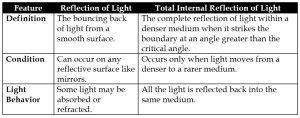
(a) Reflection of light and total internal reflection of light
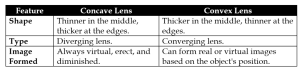
(b) Concave lens and convex lens
(c) Near point of the eye and far point of the eye

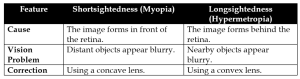
(d) Shortsightedness and longsightedness
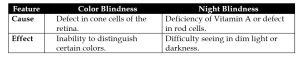
(e) Color blindness and night blindness
3. Give reasons:
(a) Between glass and water, glass is considered a denser medium and water is a rarer medium.
Ans: Glass is considered a denser medium because it has a higher refractive index than water, which means light travels slower in glass. When light passes from water to glass, it bends more towards the normal, confirming glass is optically denser.
(b) When a coin is placed in glass containing water, it appears to rise a bit.
Ans: The coin appears to rise due to refraction. As light travels from water to air, it bends away from the normal, making the coin’s image appear at a higher position than its actual location.
(c) When the letters written on the paper are observed from the top of a glass slab, the letters appear to be slightly raised.
Ans: This happens because of refraction. As light passes from the paper through the glass slab and then to air, it bends and creates an optical illusion where the letters seem to be located slightly above their original position.
(d) Stars twinkle.
Ans: Stars twinkle due to atmospheric refraction.The light from stars bends multiple times as it passes through different layers of the atmosphere, causing the light to shift in position and intensity, which makes them appear to twinkle.
(e) The sun appears on the horizon about two minutes before the actual sunrise.
Ans: Due to atmospheric refraction, the sun’s rays bend as they enter the Earth’s atmosphere. This bending causes the sun to appear slightly higher in the sky than it actually is, allowing us to see it before it has actually risen above the horizon.
4. Write short answers to the following questions:
a) What is the refraction of light?
Answer: Refraction of light is the bending of light when it passes from one transparent medium to another with a different optical density. This change in direction occurs due to a change in the speed of light in the two media. For example,
light bends towards the normal when it enters a denser medium like glass from air.
b) Write the laws of refraction of light.
Answer: There are two laws of refraction:
- First Law: The incident ray, the refracted ray, and the normal all lie in the same plane at the point of incidence.
- Second Law (Snell’s Law): The ratio of the sine of the angle of incidence to the sine of the angle of refraction is constant for a given pair of media. This is expressed as:
Sin i/Sin r = μ (constant)
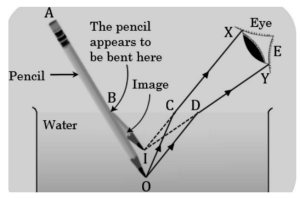
c) What change is noticed in the shape of a pencil that is half immersed in water as shown in the figure? Explain with a ray diagram. Write the name of the process associated with this observation.
Answer: When a pencil is half immersed in water as shown in the figure, it appears bent. The part of the pencil inside the water appears to be raised. Explanation: For us, to see the pencil, reflected rays of light by pencil, should pass from denser medium (water) to rarer medium (air) before reaching our eyes. So, when it comes from a denser medium (water) to a rarer medium (air) it bends away from normal. Then we see the image of the pencil that is formed slightly above the real pencil. However, the part of the pencil in the air is seen in its real place. As a result, the pencil seems bent.
The physical process involved in this activity is called the refraction of light.
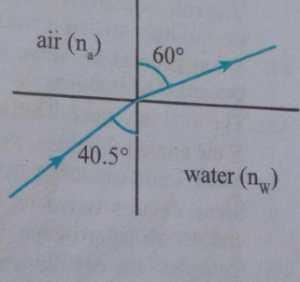
d) When a light ray passes from water to air, the angle of incidence and angle of refraction formed at the water-air separation layer are 40.5° and 60° respectively. Draw a ray diagram showing the refraction and write the reason why an object outside appears to be farther away from its actual position when it is viewed by an observer inside the water.
Answer: The light rays from an object have to first travel in the air, then go into the water and reach the eye of the observer who is inside the water. While entering water from the air, this light refracts. It bends toward the normal. As a result, the image of the object is formed at a higher place than its original place. So, the object outside the water appears to be farther away from its actual position when it is viewed by an Observer inside the water.
e) What is a critical angle?
Answer: The critical angle is the angle of incidence in a denser medium for which the angle of refraction in the rarer medium becomes 90°. Beyond this angle, the light does not pass into the rarer medium but reflects entirely back into the denser medium, resulting in total internal reflection.
f) What is total internal reflection of light?
Answer: Total internal reflection is the phenomenon in which a light ray traveling from a denser medium to a rarer medium is completely reflected back into the denser medium when the angle of incidence exceeds the critical angle. It occurs with zero transmission of light into the second medium.
g) Write two conditions necessary for total internal reflection of light.
Answer:
- The light must travel from a denser medium to a rarer medium.
- The angle of incidence must be greater than the critical angle for the pair of media involved.
h) At present, data can be transmitted at a very fast rate through fiber internet. Mention the role of total internal reflection of light in fiber internet.
Answer: Fiber internet uses optical fibers, which are thin strands of glass or plastic that transmit light signals. Inside these fibers, light undergoes total internal reflection repeatedly along the length of the cable. This prevents the signal from escaping and allows it to travel long distances with minimal loss, enabling high-speed data transmission.
i) In endoscopy, colonoscopy and keyhole surgery, how is total internal reflection of light applicable to the devices used to send light to the internal organs of the human body without incisions?
Answer: In these medical procedures, light is transmitted into the body using optical fibers. These fibers work based on total internal reflection, allowing the light to be guided through curves and bends of the fiber without loss. This enables clear visualization of internal organs and precise delivery of instruments without making large incisions.
j) What is a dispersion of light?
Answer: Dispersion of light is the process in which white light splits into its constituent colors (spectrum) when it passes through a transparent medium like a prism.
Each color in white light bends at a different angle due to its unique wavelength, producing a band of colors from violet to red.
k) Mention the reason for the dispersion of light.
Answer: Dispersion occurs because different colors (wavelengths) of light travel at different speeds in a medium. When white light enters a prism, each color bends by a different amount due to the variation in refractive index for different wavelengths. This separation of colors is known as dispersion.
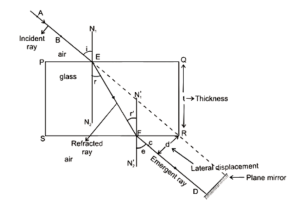
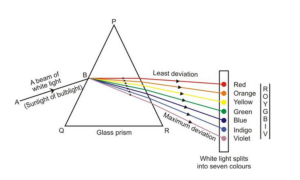
l) Draw a ray diagram showing the following processes:
- (i) Refraction of light through a glass slab
- (ii) Dispersion of light through a prism
Answer:
(i) Refraction through a glass slab:
(ii) Dispersion through a prism:
m) A person is curious to know why a rainbow always appears semicircular and of the same size. Write down the solution to his curiosity. Include in your answer the position of the sun in the rainbow, the position of the water droplets in the air and the process of dispersion of light.
Answer: A rainbow appears semicircular and of the same size because of the specific angle (about 42°) at which light is dispersed and internally reflected within water droplets in the air. The sun must be behind the observer, and water droplets must be in front of the observer. Sunlight enters each droplet, undergoes dispersion, refraction, and internal reflection, then exits the droplet, forming the circular arc. Since we see the rays coming at a specific angle, the rainbow always appears the same size and semicircular when viewed from the ground.
n) Define the following terms related to the lens:
(i) Centre of Curvature:
It is the center of the sphere from which the lens surface has been cut. A lens has two centres of curvature—one for each spherical surface.
(ii) Optical Centre:
The optical centre is a point inside the lens through which a ray of light passes without any deviation. It lies on the principal axis.
(iii) Principal Axis:
It is the imaginary straight line passing through the optical centre and both the centres of curvature of the lens.
(iv) Focus (Focal Point):
It is the point on the principal axis where rays of light parallel to the principal axis converge (in convex lens) or appear to diverge (in concave lens) after passing through the lens.
o) What is meant by the power of a lens?
Answer: The power of a lens is the measure of its ability to bend light rays. It is defined as the reciprocal of its focal length (in meters) and is expressed in diopters (D).
Power (P) = 1/Focal length(m)
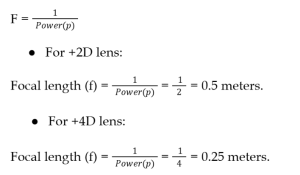
p) The powers of two convex lenses are +2D and +4D respectively.
(i) Which of them is thicker? Give reason:
The lens with +4D power is thicker. This is because a lens with greater power has a shorter focal length, and hence, must be more curved or thicker to converge light rays more strongly.
(ii) Calculate the focal length of each lens:
Using the formula:
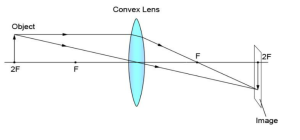
q) In which case is the image formed by a convex lens real and of the same size as the object? Show the ray diagram.
Answer: A real and same-sized image is formed by a convex lens when the object is placed at twice the focal length (2F) from the lens.
r) Will the spear thrown by the man shown in the figure, from outside the water hit the fish in the water? Explain it based on the real depth of the fish in the water.
Answer: No, the spear will miss the fish if thrown directly at its apparent position. This is due to refraction of light. When light rays from the fish travel from water (denser medium) to air (rarer medium), they bend away from the normal, making the fish appear shallower (closer to the surface) than it actually is. To hit the fish, the man must aim below the apparent position.
s) What process is shown in the ray diagram? Name any two devices that operate on this process.
Answer: The ray diagram shows the process of Total Internal Reflection (TIR). This happens when light traveling in a denser medium hits the boundary with a rarer medium at an angle greater than the critical angle, causing the light to reflect completely within the denser medium.
Two devices that operate on this process:
- Optical Fibres – used in fiber internet and communication.
- Endoscopes – used in medical imaging to view internal organs.
t) Complete the ray diagrams by copying the given figures to the answer sheet.
Answer: Take the help of your teacher and complete the ray diagrams, or check the diagrams in your book and do them accordingly.
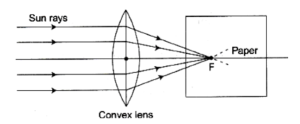
u) Mention the facts, along with the ray diagram, applicable to the uses of the lens shown in the figure.
Answer: In this application of a convex lens, the lens is used to start a fire by collecting parallel rays of light on paper. Here: The object is at infinity. The parallel rays of light are falling in the convex mirror. So the parallel rays of light must bend to meet at focus. The image of the sun will made at focus. Thermal energy will be collected at focus. Then the fire will start.
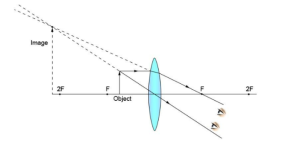
In this application of convex lens, the hand lens is used as reading glass. The letters appear raised bigger. Here: The object is very close to the lens. The letters are between the focus and the optical centre. So, a virtual and magnified image of letters is formed. Hence, it will be easy for us to read small letters.
In this application of a concave lens, the concave lens is used as a peephole. Here: The object is outside the door. Objects can be anywhere infront of the lens. It makes a virtual, diminished and erect image. So, we can see people outside the room.
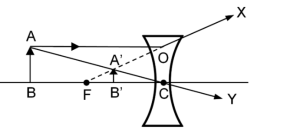
v) The given figure shows the dispersion of a light ray through a triangular prism. Answer the following:
(a) Which colours of light waves are indicated by X and Y?
Answer:
- X = Violet,
- Y = Red
(b) Why is Y bent less than X when the light rays come out of the prism?
Answer: Red light has a longer wavelength and a lower refractive index in glass compared to violet light. As a result, it undergoes less refraction. Violet, with a shorter wavelength, slows down more and bends more sharply.
w) How can the light dispersed by a prism be converted back into white light?
Answer: The dispersed light (spectrum) can be recombined using a second identical prism placed in an inverted position. The second prism bends the rays back toward each other, causing the different colors to overlap and form white light again. This process demonstrates that white light is a combination of all visible colors.
x) The focal lengths of two lenses are 20 cm and -20 cm respectively. Mention the types of these two lenses. Out of these two lenses, which one forms a virtual and magnified image when an object is kept 16 cm away from the lens? Explain with ray diagram.
Answer:
- Lens with +20 cm focal length is a convex lens.
- Lens with -20 cm focal length is a concave lens.
For an object at 16 cm:
- Since 16 cm is less than 20 cm, when the object is placed within the focal length of the convex lens, it forms a virtual, erect, and magnified image.
- The concave lens always forms virtual, erect, and diminished images.
Therefore, the convex lens forms the virtual and magnified image.
Ray Diagram Description (for convex lens):
- One ray parallel to the principal axis refracts through the focus.
- Another ray passes through the optical centre undeviated.
- The refracted rays diverge; extend them backward to form a virtual, enlarged image on the same side as the object.
y. Write the functions of the following parts of the eye:
Answer:
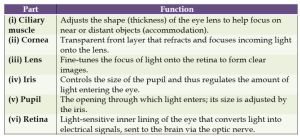
z) Write any two problems that may be seen in corneal injury.
Answer:
- Blurred or distorted vision – due to scarring or irregular surface affecting light refraction.
- Pain and sensitivity to light (photophobia) – as the cornea has many nerve endings, injuries can cause discomfort and inflammation.
27. Explain the role of the ciliary muscle in the change in the thickness of the eye lens when a student sitting in a classroom shifts his eyes from the letters written on the whiteboard to a distant object seen out the window.
Answer: When the student looks at the whiteboard (near object), the ciliary muscles contract, causing the lens to become thicker and more curved, increasing its converging power to focus the image on the retina.
When the student shifts focus to a distant object outside the window, the ciliary muscles relax, allowing the lens to become thinner and flatter, reducing its curvature so that parallel rays from distant objects can focus clearly on the retina. This ability to change the lens shape is called accommodation.
28. Identify the type of defect of vision indicated by the given ray diagram. Write two causes of the defect along with its correction.
Long-sightedness is the type of defect of vision shown in the diagram.
Two causes of the defect of vision are shortening of the eyeball, ciliary muscle relax, thin lens, flat cornea and longer focal length.
Correction of long sight:
A convex lens can be used to converge light so that the image will be formed at the retina.
29. A student has difficulty seeing the whiteboard from the last bench but can see clearly from the first bench.
(i) What type of defect of vision does the student have?
Answer: The student has myopia (short-sightedness) – difficulty seeing distant objects clearly.
(ii) Draw a ray diagram showing this type ofdefect of vision of the student.
Answer:
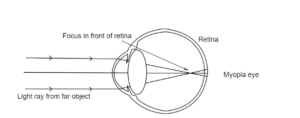
(iii) Any two causes of this defect:
Answer:
- The eyeball is elongated, so the focal point lies in front of the retina.
- The lens is too curved or thick, increasing its converging power.
(iv) Explain with ray diagram , the role of the lens used to correct this defect.
Answer: This defect of vision is corrected by using a concave lens. The roleof a concave lens is correcting this defect is to diverge the rays of light so that they meet at the retina.
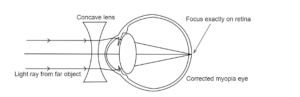
30. Explain, with a ray diagram, the role of the lens used to correct long-sightedness.
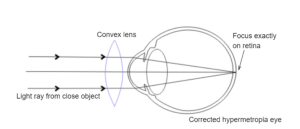
Answer: In hypermetropia, light from near objects focuses behind the retina.
A convex lens is used to converge the rays before they enter the eye. This ensures that the rays are focused on the retina, enabling clear vision.
31. A student concludes that the effect of vision defect is more on a person wearing thick lenses than one wearing thin lenses. Is this understanding correct? Justify.
Answer:
Yes, this understanding is partially correct.
Justification:
- The thickness of a lens generally depends on the severity of the defect.
- A thicker lens has more curvature, indicating a higher power (positive or negative diopters) needed to correct a stronger vision problem.
- However, modern lenses can be made thin but high-powered using advanced materials, so thickness alone does not always indicate severity.
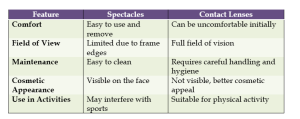
32. Compare the use of spectacles and contact lenses to correct visual defects.
Answer:
33. Explain the laser surgery method used to solve eyesight problems.
Answer:
Laser eye surgery, such as LASIK (Laser-Assisted In Situ Keratomileusis), corrects vision by reshaping the cornea using a laser beam. The reshaping changes the cornea’s focusing power, so light rays fall exactly on the retina, correcting defects like myopia, hypermetropia, and astigmatism. The procedure is quick, nearly painless, and reduces or eliminates the need for glasses or contact lenses.
34. What is a cataract? Write the role of the intraocular lens developed by Nepal’s ophthalmologist Dr. Sanduk Ruit in the treatment of cataracts.
Answer:
Cataract:
A cataract is a condition where the natural lens of the eye becomes cloudy, leading to blurred vision, glare sensitivity, and eventual blindness if untreated.
Dr. Sanduk Ruit’s Contribution:
Dr. Ruit developed a low-cost intraocular lens (IOL) that can be implanted to replace the cloudy natural lens during cataract surgery. His innovation made cataract treatment affordable and accessible, especially in developing countries, restoring sight to millions of patients worldwide.