Class 10 Science Lesson 7 Note
#Unit -7 Motion and Force
1. Choose the correct options for the given questions.
(a) What is the relation between the distance between two objects (d) and the gravitational force (F) produced between them?
(i) F ∝ d
(ii) F ∝ d²
(iii) F ∝ 1/d²
(iv) F ∝ d
Answer: (iii) ) F ∝ 1/d²
(b) What is the change in the gravitational force between two objects when their mass is doubled?
(i) the force doubles
(ii) the force becomes four-time
(iii) the force is reduced two times
(iv) the force is decreased four times
Answer: (ii) the force becomes four-time
(c) If the gravitational force between two objects on Earth is 60 N, what is the gravitational force between those two objects on the moon?
(i) 10 N
(ii) 6 N
(iii) 9.8 N
(iv) 60 N
Answer: (ii) 6 N
(d) Which one of the following statements is correct?
(i) The value of acceleration due to gravity increases as we go deeper from the surface of the earth.
(ii) The value of acceleration due to gravity decreases as the height above the surface of the earth increases.
(iii) The value of acceleration due to gravity is less in the polar region than that in the equatorial region.
(iv) The value of the acceleration of gravity is highest at the highest place on the Earth.
Answer: (ii) The value of acceleration due to gravity decreases as the height above the surface of the earth increases.
(e) At which of the following places do you weigh the most?
(i) peak of Mount Everest
(ii) peak of Api Himal
(iii) Kechnakwal of Jhapa
(iv) Chandragiri Hills
Answer: (iii) Kechnakwal of Jhapa
(f) The radius of the Earth is 6371 km and the weight of an object on the Earth is 800 N. What is the weight of the object at a height of 6371 km from the surface of the Earth?
(i) 800 N
(ii) 1600 N
(iii) 200 N
(iv) 3200 N
Answer: (iii) 200 N
(g) If the mass and the radius of a celestial body are two times the mass and the radius of the Earth respectively, what is the value of acceleration due to the gravity of that body?
(i) 9.8 m/s²
(ii) 4.9 m/s²
(iii) 19.6 m/s²
(iv) 10 m/s²
Answer: (ii) 124.74 N
(h) What will be the weight of a man on the moon, if his weight on Earth is 750 N? (The acceleration due to the gravity of the moon = 1.63 m/s²)
(i) 124.74 N
(ii) 125 N
(iii) 126.8 N
(iv) 127.8 N
Answer: (i) 124.74 N
(i) The mass of planet B is twice the mass of planet A but its radius is half of the radius of planet A. Similarly, the mass of planet C is half of the mass of planet A, but its radius is twice the radius of planet A. If the weight of an object in planets A, B and C is W₁, W₂ and W₃ respectively, which of the following order is correct?
(i) W₁ = W₂ = W₃
(ii) W₁ > W₂ > W₃
(iii) W₁ < W₂ < W₃
(iv) W₂ > W₁ > W₃
Answer: (iv) W₂ > W₁ > W₃
(j) Which one of the following conclusions is correct while observing a freely falling object every second?
(i) the distance covered increases uniformly
(ii) velocity increases uniformly
(iii) acceleration increases uniformly
(iv) translation takes place uniformly
Answer: (ii) velocity increases uniformly
2. Write Differences:
a) Gravitational Constant (G) and Acceleration due to Gravity (g):

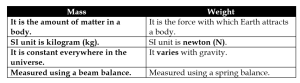
(b) Mass and Weight:
3. Give reasons:
(a) Why is acceleration due to gravity not the same in all parts of the Earth?
Ans: Acceleration due to gravity varies because the Earth is not a perfect sphere; it is flattened at the poles and bulged at the equator, causing gravity differences. Also, variations in Earth’s mass distribution like mountains and density changes affect the local gravity values.
(b) Why may jumping from a significant height cause more injury?
Ans: Jumping from a height causes the body to gain speed due to gravity, increasing the force of impact upon landing. The greater impact transfers more energy to the body, resulting in more severe injuries.
(c) Why is the acceleration due to gravity on Jupiter only about 2.6 times that of Earth even though its mass is about 319 times Earth’s?
Ans: Although Jupiter’s mass is much larger, its radius is also much bigger, which reduces the effect of gravity on its surface. Gravity depends on mass divided by the square of the radius, so the large radius lowers Jupiter’s surface gravity.
(d) Why does an object dropped from the same height fall faster in the polar region than at the equatorial region?
Ans: Gravity is stronger at the poles because the Earth’s shape makes the poles closer to its center. Also, Earth’s rotation causes a centrifugal force that reduces gravity more at the equator than at the poles.
(e) Why does a folded paper ball fall faster than a flat sheet of paper when dropped simultaneously?
Ans: The folded paper ball has a smaller surface area, so it experiences less air resistance. The flat sheet faces more air resistance, which slows it down compared to the ball.
(f) Why do a marble and a feather dropped simultaneously in a vacuum reach the ground at the same time?
Ans: In a vacuum, there is no air resistance to slow down the feather. Both the marble and the feather accelerate equally under gravity, causing them to fall together.
(g) Why does the weight of goods you carry decrease as you climb Mount Everest?
Ans: Weight decreases with height because gravitational force weakens as the distance from Earth’s center increases. Since gravity varies inversely with the square of the distance, climbing higher reduces your weight.
(h) Why is it difficult to lift a big stone but easy to lift a smaller one?
Ans: A bigger stone has greater mass and thus more weight due to gravity, requiring more force to lift. A smaller stone weighs less, making it easier to lift.
(i) Why does the mass of an object remain constant but its weight vary from place to place?
Ans: Mass is the amount of matter and remains the same everywhere. Weight depends on gravitational force, which varies with location, causing weight to change.
(j) Why does one feel an eerie sensation when moving down while playing on a rope swing?
Ans: The downward acceleration affects the balance organs in the inner ear. This change causes dizziness or an unsettling feeling during the motion.
4. Answer the following Questions:
a) What is gravity?
Answer: Gravity is the force by which the Earth or any other celestial body attracts objects towards its center. It is a universal force acting between all masses.
(b) State Newton’s universal law of gravitation.
Answer: Newton’s universal law of gravitation states that every point mass in the universe attracts every other point mass with a force that is directly proportional to the product of their masses and inversely proportional to the square of the distance between them. Mathematically,

Where F is the gravitational force, m1 and m2 are the masses, d is the distance between them, and G is the gravitational constant.
(c) Write the nature of gravitational force.
Answer: Gravitational force is always attractive, acts along the line joining the centers of two masses, is universal force acting between all masses, and is inversely proportional to the square of the distance between the masses.
(d) Define gravitational constant (G).
Answer: The gravitational constant GG is a universal constant that appears in Newton’s law of gravitation. It quantifies the strength of gravity and has a value of approximately 6.674×10 -11 Nm2 /kg2 .
(e) Under what conditions is the value of gravitational force equal to the gravitational constant (F = G)?
Answer: The gravitational force FF equals the gravitational constant GG when the product of the masses divided by the square of the distance between them equals one unit, i.e.

(f) Write two effects of gravitational force.
Answer:
- It keeps planets in orbit around the Sun.
- It causes objects to fall towards the Earth’s surface.
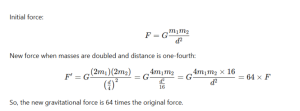
(g) Mathematically present the difference in gravitational force between two objects when the mass of each is made double and the distance between them is made one-fourth their initial distance.
Answer:
(h) What is gravitational force?
Answer: Gravitational force is the attractive force that acts between any two masses in the universe. It depends on their masses and the distance between them.
(i) Define acceleration due to gravity.
Answer: Acceleration due to gravity (g) is the acceleration experienced by an object when it is in free fall near the surface of a celestial body, caused by the gravitational pull of that body. On Earth, it is approximately 9.8 m/s2.
(j) What is free fall? Give two examples of it.
Answer: Free fall is the motion of an object falling under the influence of gravity only, with no other forces acting on it (like air resistance).
Examples:
- A stone dropped from a tower.
- An apple falling from a tree.
(k) Under what conditions is an object said to be in free fall?
Answer: An object is said to be in free fall when it moves under the influence of gravity alone, without any air resistance or other forces acting on it.
(l) Write the conclusions of the feather and coin experiment.
Answer: When a feather and a coin are dropped in a vacuum, they fall at the same rate and reach the ground simultaneously. This shows that in the absence of air resistance, all objects accelerate equally due to gravity regardless of their mass or shape.
(m) What is weightlessness?
Answer: Weightlessness is the condition experienced when there is no net gravitational force acting on a body or when an object is in free fall, causing the sensation of zero weight, such as astronauts feel in orbit.
(n) Mention any four effects of gravitational force.
Answer:
- Keeps planets in orbit around the Sun.
- Causes tides due to the Moon’s gravity on Earth.
- Holds the atmosphere around the Earth.
- Enables objects to fall towards Earth’s surface.
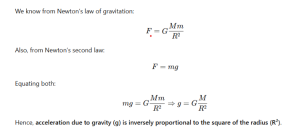
(o) Prove that acceleration due to gravity of the Earth is inversely proportional to the square of its radius.
Answer:
p) Mention the factors that influence acceleration due to gravity.
Answer:
- Altitude – g decreases with height above Earth’s surface.
- Depth – g decreases with depth below Earth’s surface.
- Latitude – g is greater at the poles than at the equator.
- Shape of Earth – Due to the Earth’s bulge at the equator and flattening at the poles.
(q) The acceleration due to gravity on the Earth’s surface is 9.8 m/s². What does this mean?
Answer: This means that any object falling freely near the Earth’s surface increases its velocity by 9.8 meters per second every second due to gravity, regardless of its mass.
(r) If the Earth is squeezed to the size of the Moon, what will be the effect on its acceleration due to gravity?
Answer:

(s) The acceleration due to gravity is 2 m/s² at a point in space for a 1 kg object. What is it for a 10 kg object at the same point?
Answer: 2 m/s²
Gravitational acceleration does not depend on mass of the object. Both 1 kg and 10 kg objects experience the same acceleration (2 m/s²) at that point.
(t) A man measures mass and weight in mountain and Terai. Compare the results.
Answer:
- Mass remains the same in both places, as it is independent of gravity.
- Weight is more in the Terai than in the mountain because gravity is slightly stronger at lower altitudes (closer to Earth’s center).
(u) A student suggests buying oranges from the mountain and selling in Terai using beam balance. Is his trick right?
Answer:
His trick is wrong.
Beam balance compares mass, not weight. Since, mass remains the same everywhere, the same quantity of oranges will weigh equally on both sides of the balance in mountain and Terai, leading to no profit through this method.
(v) How is it possible to land safely using a parachute? Can the same method work on the Moon? Explain.
Answer:
Parachutes increase air resistance, slowing the fall and allowing a safe landing on Earth. On the Moon, however, there is no atmosphere, so parachutes don’t work. Safe landing on the Moon requires rocket boosters or other technologies to slow descent.
(w) Why does acceleration depend on mass in horizontal motion but not in free fall?
Answer: